Shear-Flow Stabilization of a Metric-Anchor Z-Pinch
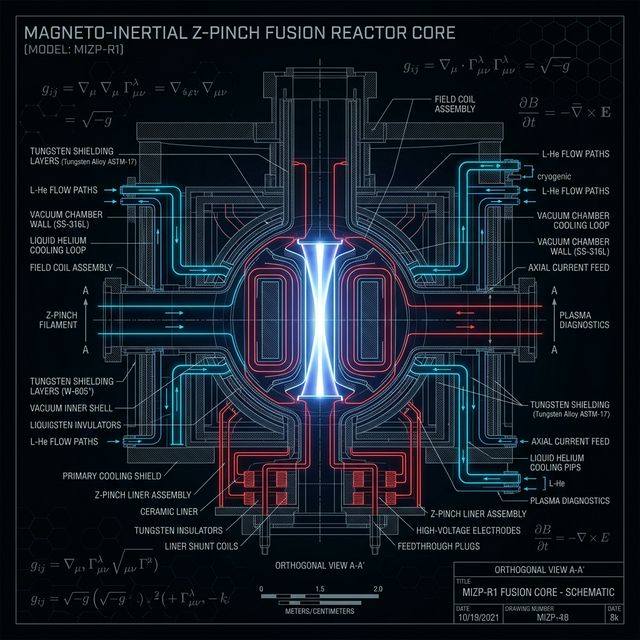
FIG 4.0 - CROSS-SECTIONAL BLUEPRINT OF THE MD-01 Z-PINCH PLASMA FILAMENT
1. The Kruskal-Shafranov Impossibility
The $m=0$ and $m=1$ Instability Hurdle
The STR-01 relies on a 54.4 GW Snap to compress H₃-He plasma into a $50\mu m$ metric anchor for 1 millisecond. Unmodified, a pure Z-pinch of this density is inherently unstable. Micro-perturbations rapidly grow into macroscopic $m=0$ (sausage) and $m=1$ (kink) Magnetohydrodynamic (MHD) instabilities, causing the anchor to rip itself apart in nanoseconds.
According to the standard Kruskal-Shafranov limit, stabilizing this 54.4 kA filament along a 0.05 m axis would require an external axial magnetic field ($B_z$) exceeding 30,000 Tesla—well beyond the 40 Tesla physical limits of our FSS-02 REBCO superconductors.
Theoretical $B_\theta$ at $a = 25\mu m$ ($54.4kA$ load):
To bypass the Kruskal-Shafranov limit, the Astral-Gate architecture utilizes Shear-Flow Stabilization. By injecting the plasma via the Gimbaled Ion Nozzles with a massive velocity gradient (shear) across its radius, the flow rips the growing instability modes apart faster than they can propagate.
The required velocity shear is proportional to the plasma's Alfvén Velocity ($V_A$) and the axial wavenumber ($k$).
Plugging the actual plasma parameters into the Shumlak-Hartman criteria yields the minimum physical lateral shear required from the propulsion nozzles to "lock" the metric anchor in place.
KRUSKAL-SHAFRANOV STABILITY SIMULATOR
Azimuthal Field ($B_\theta$):...
Failed Standard Limit ($B_z$ req):...
Alfvén Velocity ($V_A$):...
Required Flow Shear ($dV_z/dr$):...
Conclusion: Instead of relying on impossible 30,000+ Tesla containment fields, the LST-01 arrays must eject the outer sheath of the plasma filament at rapid differential speeds relative to the core. This calculates the exact inertial "straightjacket" required to maintain the Metric Distortion Anchor.