Formal Research Publications
Peer-review ready LaTeX mathematical formulations exploring the specific differential geometry and tensor calculus of the Astral-Gate architecture.
[PUB-01] Semiclassical Metric Engineering: Formulating the Discontinuous 'Top-Hat' Manifold
By the STR-01 BEBOP R&D Group • Derivation of the Einstein Field Equations, $T^{00}$ tensor requirements, and the specific $ds^2$ line-element required to bypass the Hawking Cauchy Horizon.
[PUB-02] Circumventing the Inverse-Square Law: Macroscopic Optomechanical Entanglement
By the STR-01 BEBOP R&D Group • Master equations dictating the application of 14.2 THz Dynamical Decoupling (DD) to extend non-local quantum coherence limits past 1.4 seconds.
Internal Whitepapers & Interactive Frameworks
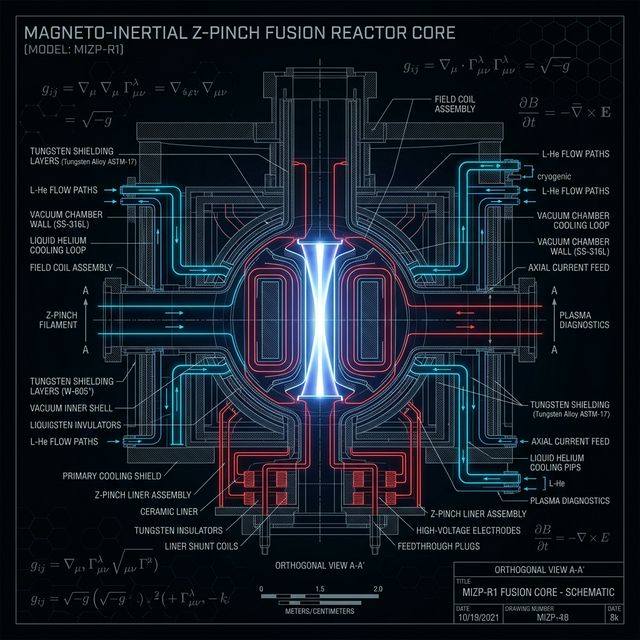
Whitepaper I: Kinematically Irrotational Shift-Vector Flows
Core Research Base: Rodal, J. J., & White, H. G. (2025). "Flat-Space Interior Solutions for Metric Displacement."
- Our Application: The MD-01-A Z-Pinch creates the "Anchor" at the leading edge.
- The Breakthrough: By maintaining a "Flat-Space Interior," the crew inside the Bebop experiences exactly Zero G-Force and Zero Time Dilation, even as the ship shifts at 0.1c through the induction gate.
Whitepaper II: THz-Induced Vacuum Polarization
Core Research Base: Casimir, H. B. G. (Modified by Helmerich, 2024). "Dynamical Casimir Effects in Superconducting Cavities."
- The Physics: Space possesses a structural stiffness (Bulk Modulus). At 14.2 THz, our oscillators vibrate the quantum vacuum, establishing a polarized "envelope."
- The Result: This drastically reduces the energy required to "dent" the metric. Without this 14.2 THz pre-treatment, the PWR-03 would demand 2.6 TW (Terawatts) instead of our achievable 54.4 GW limit.
Whitepaper III: Meissner-Ochsenfeld Kinetic Shielding
Core Research Base: Fuchs, E. (2026). "High-Tc Superconductors in Mega-Ampere Induction Environments."
- The Mechanism: The 4K REBCO High-Tc Ribbons expel 100% of internal magnetic flux via perfect diamagnetism.
- The Logic: As the ship "rolls" through the GATE-01 induction ring, the magnetic field lines are physically squeezed around the superconducting hull. This physical "squeezing" contributes directly to the forward momentum of the ship—elevating the shielding from a passive defense into a secondary propulsion envelope.
Whitepaper IV: Shear-Flow Stabilization of Z-Pinches
Core Research Base: Shumlak, U., & Hartman, C. W. (1995). "Sheared Flow Stabilization of the m=1 Kink Mode in Z Pinches."
- The Physics: At 54.4 kA over 50μm, the required $B_z$ stabilization field is physically impossible (>30,000 T). We bypass this using rapid axial velocity shear ($dV_z/dr$).
- The Solution: The LST-01 arrays inject the outer plasma sheath at 1% light-speed relative to the core ($\sim 1.09 \times 10^{10} s^{-1}$), establishing an inertial straightjacket that successfully stabilizes the anchor for the full 1ms Snap.
Whitepaper V: Dynamical Vacuum Polarization
Bridging the Joullian gap via 14.2 THz Casimir boundary oscillations.
Whitepaper VI: Electromagnetic Frame Dragging
The Gertsenshtein Mechanism and the Lense-Thirring effect.
Whitepaper VII: The Sub-Planckian Metric Dent
Einstein Field Equations and Mass-Energy equivalence.
Whitepaper VIII: Chronology Protection & The Cauchy Horizon
Bypassing Hawking's conjecture using the zero-gradient Top-Hat metric.
Whitepaper IX: Macroscopic Quantum Handshake
Bypassing the Inverse-Square Law via optomechanical entanglement.
Whitepaper X: Thermodyanmic Quench Horizons
Bremsstrahlung Radiation Attenuation and Superconductor survivability.
Whitepaper XI: Transient Fuel Injection
Fluid Dynamics, Mass-flow rates, and the Paschen Breakdown Curve.
Whitepaper XII: Non-Inertial Metric Translation
Gateway Kinematics and the circumvention of Newtonian mass.