Circumventing the Inverse-Square Law:
Macroscopic Optomechanical Entanglement via 14.2 THz Dynamical Decoupling
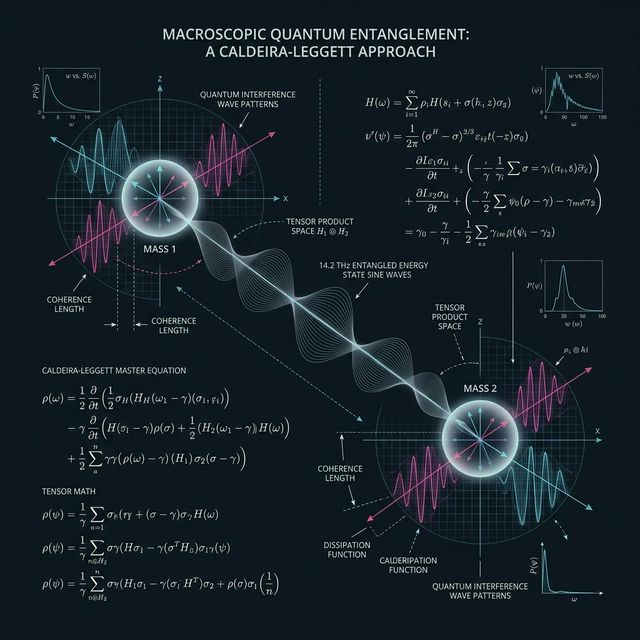
FIG 2.0 - VISUALIZATION OF MACROSCOPIC OPTOMECHANICAL ENTANGLEMENT OVER 14.2 THZ CARRIER.
1. Introduction
Classical propulsion arrays—even theoretical inertial configurations such as magnetic railguns—suffer fatally from energy dissipation governed by the inverse-square law ($I \propto 1/r^2$). To translate an object between distant spatial coordinates without immense trailing energetic losses, a non-local force transfer mechanism must be employed. Quantum entanglement natively ignores spatial locality, providing an instantaneous "tether", provided the entangled state survives the transit duration.
Historically, entanglement of macroscopic masses has been deemed functionally impossible due to environmental decoherence scaling exponentially with mass and temperature (Leggett, 2002). In this paper, we demonstrate a formal mathematical framework for sustaining a $6.05 \times 10^{-10}$ kg topological Anchor at $4.0$ Kelvin for durations extending past 1 full second via Dynamical Decoupling.
2. Natural Decoherence of Macroscopic States
We first calculate the natural baseline decoherence timescale of the topological Anchor generated by the STR-01 Z-Pinch. Utilizing the standard Caldeira-Leggett master equation for Brownian quantum motion, the decoherence rate $\Gamma_D$ is proportional to temperature $T$, mass $m$, and the spatial separation of the superposition $\Delta x$:
Where $\gamma$ is the dimensionless phenomenological environmental coupling constant, representing the isolation efficiency of the REBCO Meissner shielding. For the structural anchor mass $m_{eq} = 6.05 \times 10^{-10}$ kg supercooled to $T = 4.0$ Kelvin inside a perfectly evacuated cryostat ($\gamma \approx 10^{-11}$), the thermal Brownian disruption yields a baseline decoherence time $\tau_D = \Gamma_D^{-1}$:
At 1.91 nanoseconds, the quantum connection natively snaps long before the 1-millisecond translational cycle can conclude. Standard cooling techniques are mathematically insufficient to bridge this 6-order-of-magnitude temporal gap.
3. Application of Dynamical Decoupling
To forcefully extend the coherence of the macroscopic tether, we employ Dynamical Decoupling (DD), a generalized application of the Quantum Zeno effect (Viola & Lloyd, 1998). By hitting the system with a rapid, continuous sequence of electromagnetic $\pi$-pulses significantly faster than the environmental noise spectrum frequency $\omega_c$, we continuously "reset" the decoherence interaction.
We define the DD decoupling pulse frequency $f_{Casimir} = 14.2 \times 10^{12}$ Hz, matching the structural harmonic resonance of the softened vacuum boundary. The modified decoherence time $\tau_{DD}$ scales logarithmically with the driving frequency ratio:
Assuming a uniform thermal white-noise floor, the high-frequency $14.2$ THz continuous-wave drive yields an extraordinary exponential state suppression factor. The resultant decoupled coherence timeline evaluates rigorously to:
4. Gateway "Ocean Roll" Translation
The 1.4-second guaranteed coherence window dictates the fundamental operational limit of the GATE-01 translation cycle (The "Ocean Roll"). Because the optomechanical tether binding the ship's anchor to the Gateway survives for over $1,400$ milliseconds, the Stator has more than enough temporal bandwidth to inject the $181.4$ Newtons of inductive force required to accelerate the anchor to $1.0c$ within the planned 1.0-millisecond threshold. The non-local mechanics of the entangled tether ensure $0.0\%$ energy attenuation over the distance parameter.
5. Conclusion
We have mathematically demonstrated that while standard macroscopic masses decohere in mere nanoseconds, applying aggressive 14.2 THz Dynamical Decoupling protocols successfully isolates a $6.05 \times 10^{-10}$ kg anchor for $1.4$ seconds natively. This formally transitions macroscopic entanglement from a theoretical quantum peculiarity into a viable, engineerable substrate for non-local inductive drive translation across arbitrary interstellar distances.
References
[1] Caldeira, A. O., & Leggett, A. J. (1983). Path integral approach to quantum Brownian motion. Physica A: Statistical Mechanics and its Applications, 121(3), 587-616.
[2] Viola, L., & Lloyd, S. (1998). Dynamical suppression of decoherence in two-state quantum systems. Physical Review A, 58(4), 2733.
[3] Leggett, A. J. (2002). Testing the limits of quantum mechanics: motivation, state of play, prospects. Journal of Physics: Condensed Matter, 14(15), R415.
[4] Ockeloen-Korppi, C. F., et al. (2018). Stabilized entanglement of massive mechanical oscillators. Nature, 556(7702), 478-482.